contact

fr

en

中文

7:25 PM

16/02/2026

47 Rue de Turenne, 75003 Paris

7:25 PM

16/02/2026

47 Rue de Turenne, 75003 Paris

fr

en

中文

7:25 PM

16/02/2026

47 Rue de Turenne, 75003 Paris

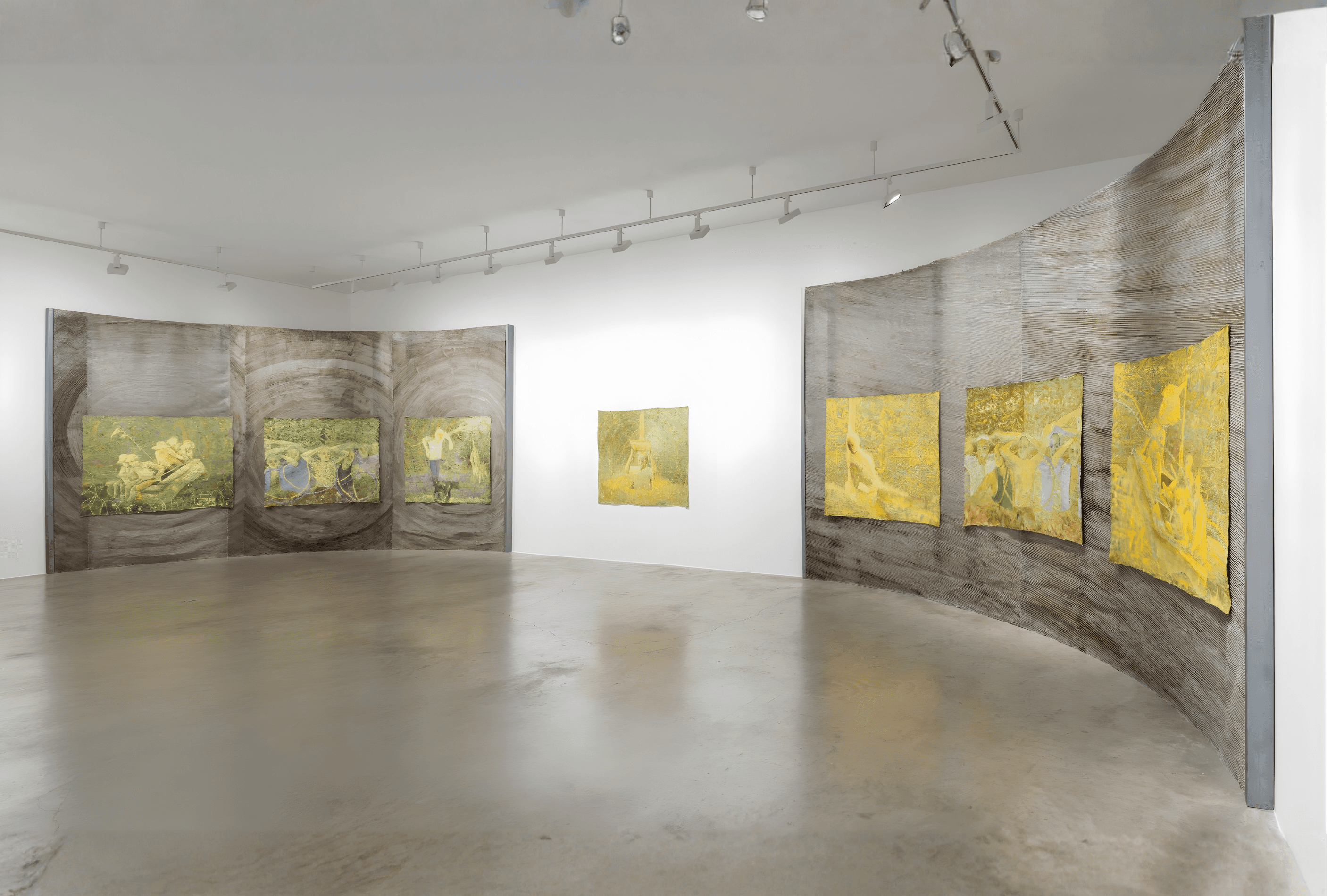
View of Kathia St. Hilaire's exhibition 'The Vocals of the Chaotic Burst' at Perrotin Paris, 2026. Photo: Claire Dorn. Courtesy of the artist and Perrotin

kathia st. hilaire

kathia st. hilaire

the vocals of the chaotic burst

the vocals of the chaotic burst

artist info

january 10 - march 7, 2026

january 10 - march 7, 2026

paris

paris

47 rue de Turenne
75003 Paris France

47 rue de Turenne
75003 Paris France

OuiParis is pleased to present The Vocals Of The Chaotic Burst, Kathia St. Hilaire's first solo exhibition in France. Kathia St. Hilaire’s work brings together printmaking, painting, collage, and weaving to create richly textured surfaces. Her compositions are built through an intensive printmaking process, often layering dozens of impressions made from carved linoleum blocks. Ink is pressed repeatedly into the surface, producing dense fields of color and pattern shaped by time, pressure, and repetition. The layered nature of her process reflects the layered histories she explores. Born in West Palm Beach, Florida, to parents who immigrated from Haiti, St. Hilaire engages with the long and complex history of the island nation. Her work reflects the lasting effects of colonial rule, foreign occupation, and political struggle, as well as the lived experience of Haitian diasporic communities in the United States. St. Hilaire is drawn to histories that have been overlooked, erased, or deliberately silenced. She approaches these narratives by blending historical research with myth, symbolism, and imagination, an approach she has described as a form of magical realism. Her compositions hold both documented events and legendary figures, allowing fact and fiction to exist side by side.


OuiParis is pleased to present The Vocals Of The Chaotic Burst, Kathia St. Hilaire's first solo exhibition in France. Kathia St. Hilaire’s work brings together printmaking, painting, collage, and weaving to create richly textured surfaces. Her compositions are built through an intensive printmaking process, often layering dozens of impressions made from carved linoleum blocks. Ink is pressed repeatedly into the surface, producing dense fields of color and pattern shaped by time, pressure, and repetition. The layered nature of her process reflects the layered histories she explores. Born in West Palm Beach, Florida, to parents who immigrated from Haiti, St. Hilaire engages with the long and complex history of the island nation. Her work reflects the lasting effects of colonial rule, foreign occupation, and political struggle, as well as the lived experience of Haitian diasporic communities in the United States. St. Hilaire is drawn to histories that have been overlooked, erased, or deliberately silenced. She approaches these narratives by blending historical research with myth, symbolism, and imagination, an approach she has described as a form of magical realism. Her compositions hold both documented events and legendary figures, allowing fact and fiction to exist side by side.


Jérémie Vespers I // Jeremie Vespers II


Jérémie Vespers I // Jeremie Vespers II

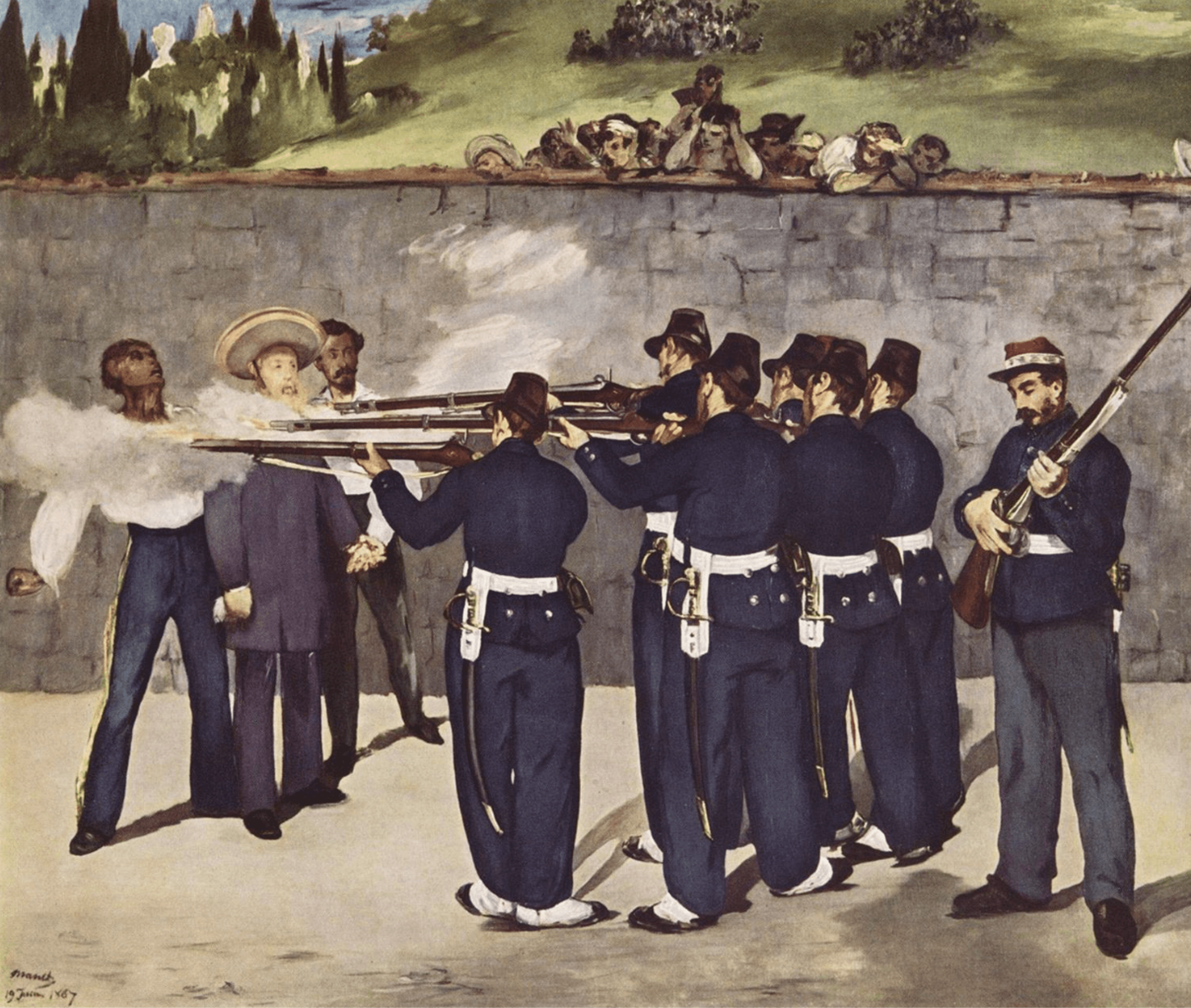
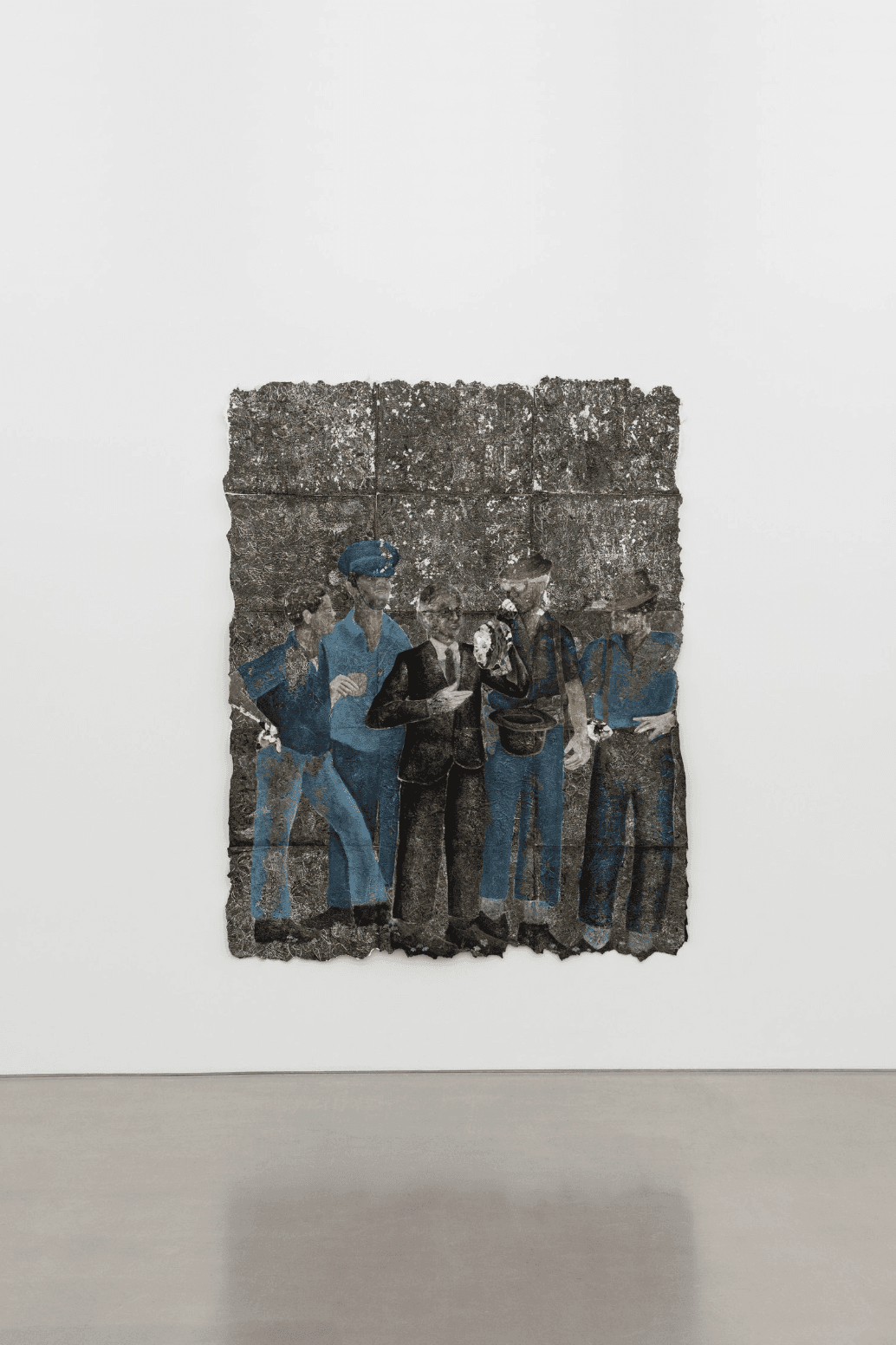
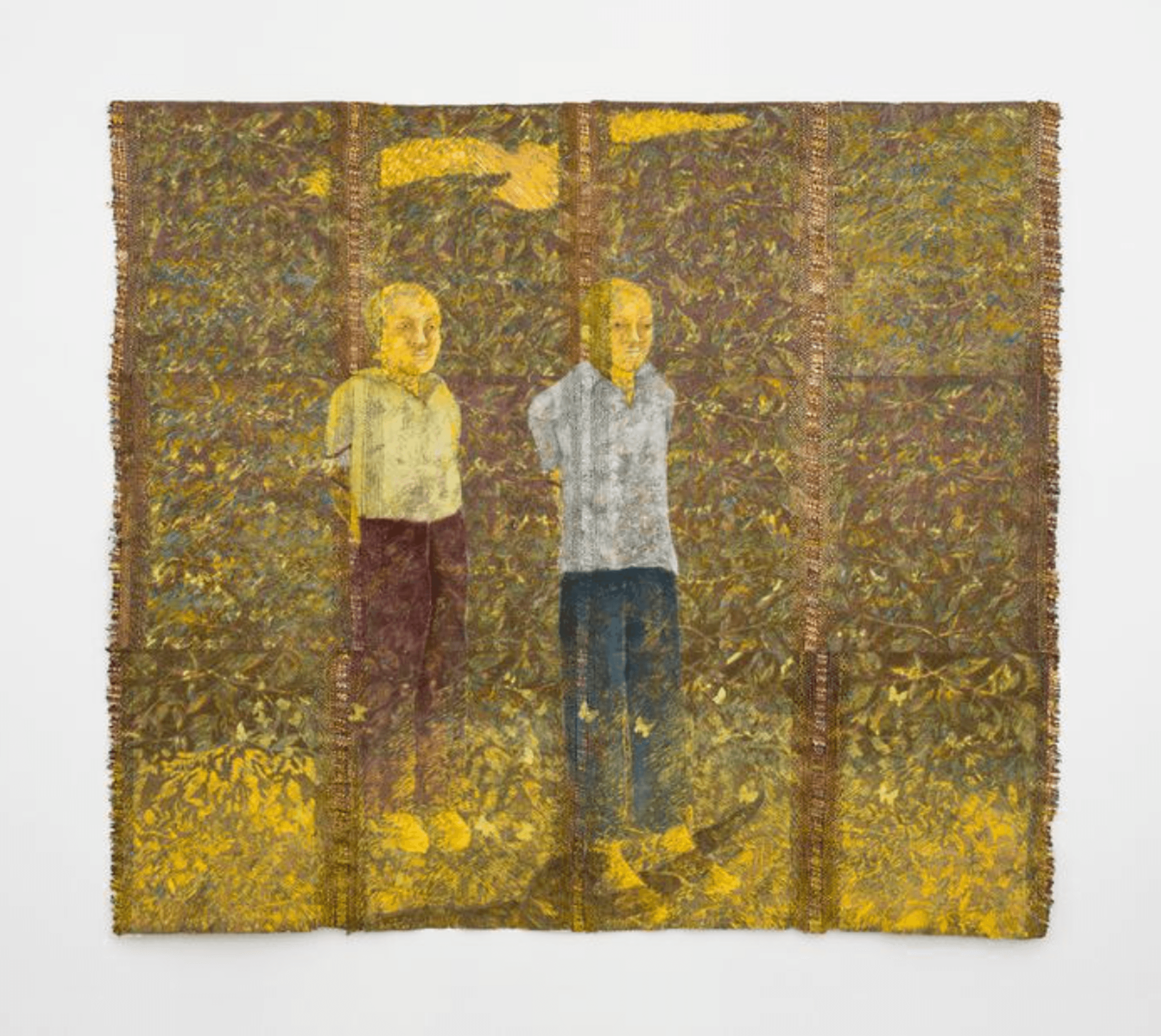
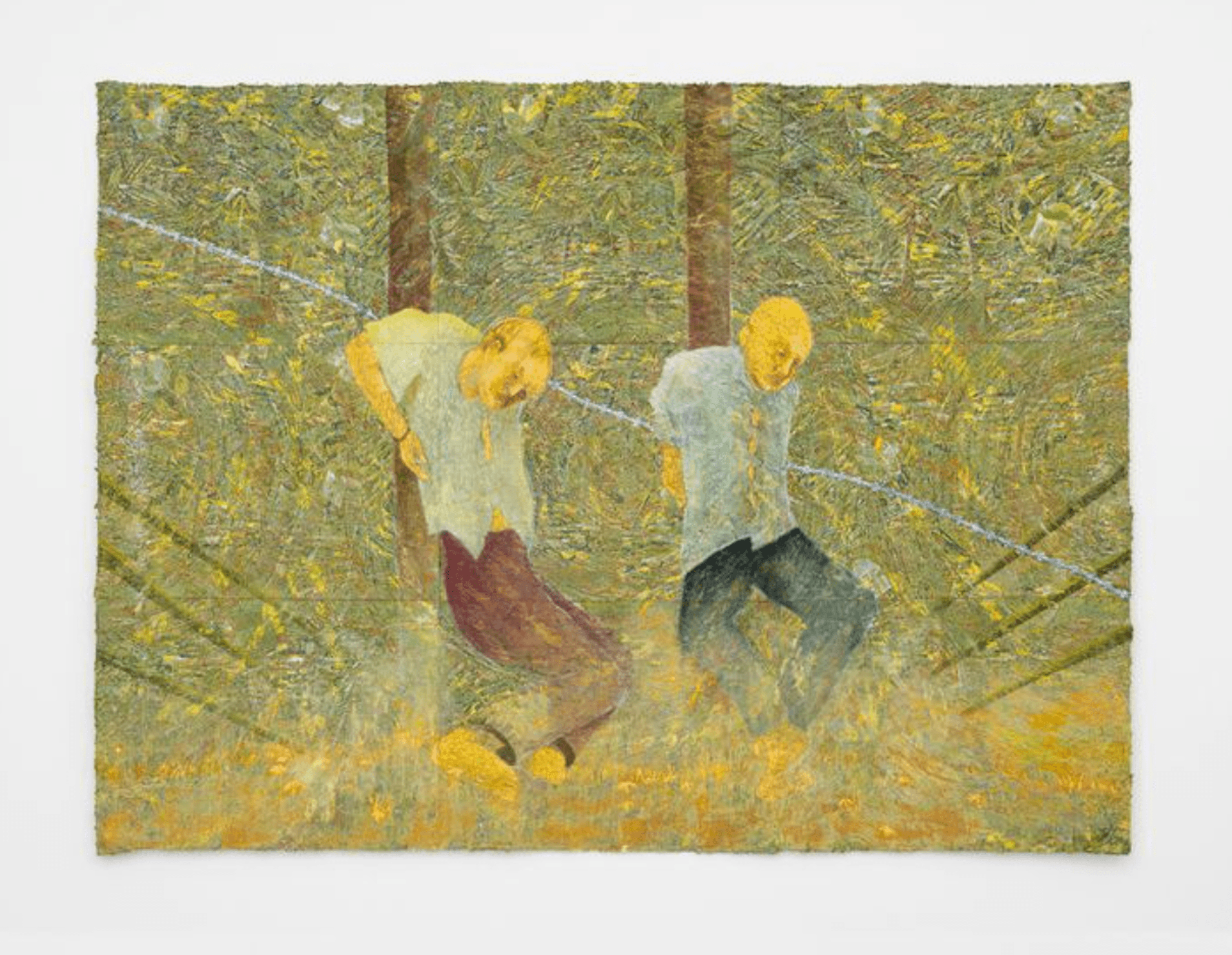
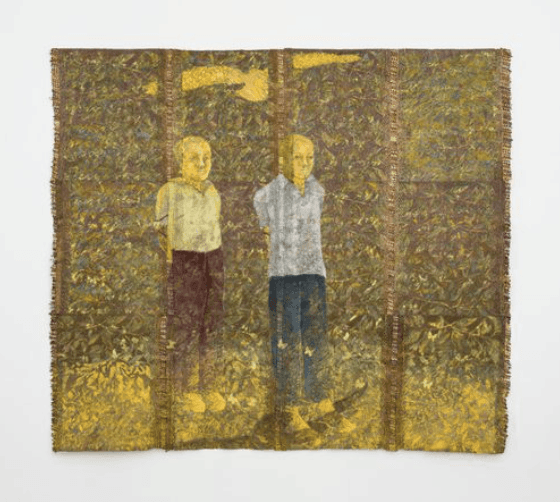
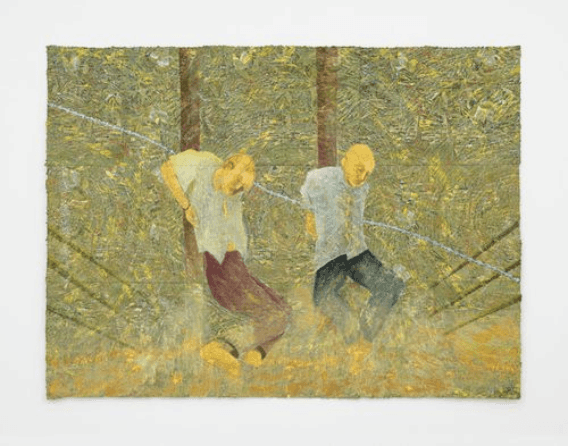
St. Hilaire draws inspiration from Haitian history in this work. Jérémie, a seaside town located in northwestern Haiti, was host to a military massacre in 1964. A group of young dissenters to the dictatorship of François Duvolier arrived near Jérémie, located in a more remote and rural area, in August of 1964 and were hunted through the area by the Haitian military for three months before their final stand in November. The military massacred many in the town of Jeremie, capturing only two survivors from the original group and bringing them to Port-au-Prince for a public execution. St. Hilaire depicts the two surviving rebels here, tied to posts in Port-au-Prince and prepared for execution. Through a magical realist lens, the artist paints the scene of the execution. Without directly painting the military, the massacre, or any figures related to the regime of Duvalier, St. Hilaire alludes to these shadowy forces of chaos, and the uncertainty of life under dictatorship.

St. Hilaire draws inspiration from Haitian history in this work. Jérémie, a seaside town located in northwestern Haiti, was host to a military massacre in 1964. A group of young dissenters to the dictatorship of François Duvolier arrived near Jérémie, located in a more remote and rural area, in August of 1964 and were hunted through the area by the Haitian military for three months before their final stand in November. The military massacred many in the town of Jeremie, capturing only two survivors from the original group and bringing them to Port-au-Prince for a public execution. St. Hilaire depicts the two surviving rebels here, tied to posts in Port-au-Prince and prepared for execution. Through a magical realist lens, the artist paints the scene of the execution. Without directly painting the military, the massacre, or any figures related to the regime of Duvalier, St. Hilaire alludes to these shadowy forces of chaos, and the uncertainty of life under dictatorship.

Edouard Manet, The Execution of Emperor Maximilian, 1868/1869, oil on canvas, 252 cm x 302 cm. ©Kunsthalle Mannheim
kathia st. Hilaire

Jérémie Vespers I, 2026

Acrylic and oil relief on canvas backed with muslin collage and woven with steel and skin

lightening cream packaging

213.4 x 160 cm|84 x 63 inches

Details & Inquiry
kathia st. Hilaire

Jérémie Vespers II, 2026

Acrylic and oil relief on canvas, barbed wire, backed with muslin

Approx: 149.9 × 129.5 cm | 59 × 51 inches

Details & Inquiry

Spiral Executions
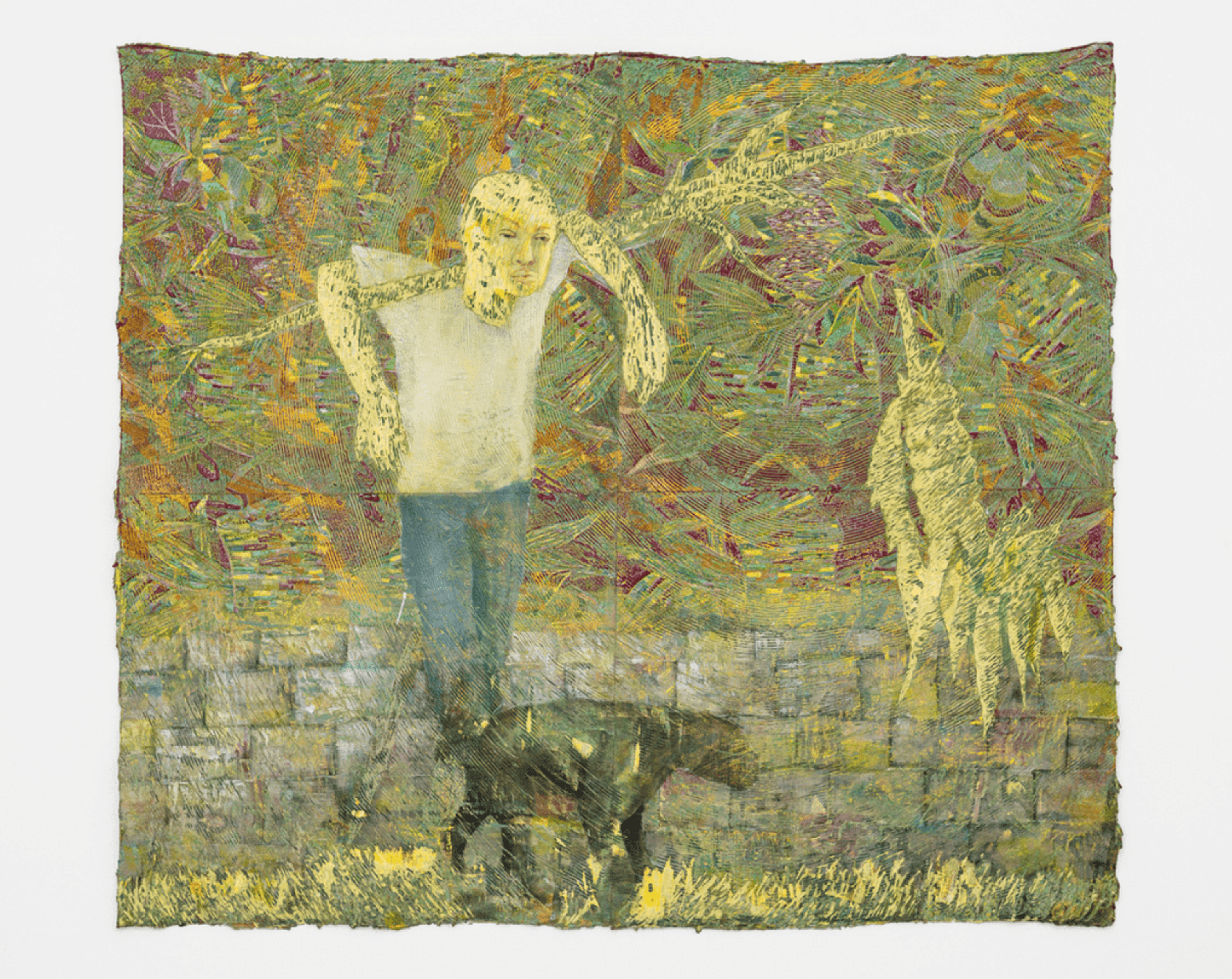
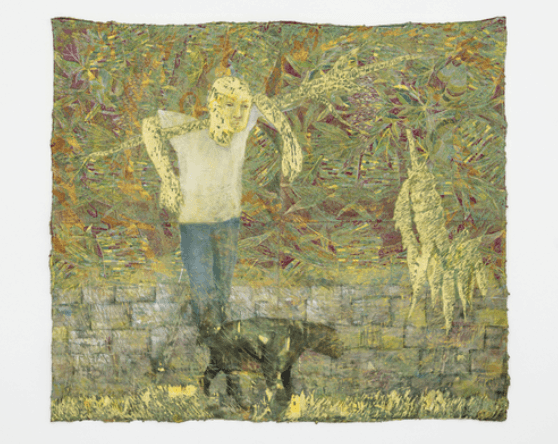
During the dictatorship of Francois Duvalier, he experienced a heart attack in 1959 that left him unconscious for over nine hours. During his hospitalization, the country was run by Clement Barbot, the head of his paramilitary group, the Tonton Macoute. Following the heart attack, it is hypothesized that Duvalier sustained neurological damage and became increasingly paranoid. He detained Barbot, convinced he was trying to gain permanent control of the country. After Barbot’s release, Duvalier became convinced that Barbot had transformed himself into a black dog, and thus ordered the Tonton Macoute to kill all black dogs in the country. Highlighting the paranoia, murkiness, and chaos of this era, St. Hilaire depicts a black dog here, running past the ankles of a man being executed by the paramilitary group.


During the dictatorship of Francois Duvalier, he experienced a heart attack in 1959 that left him unconscious for over nine hours. During his hospitalization, the country was run by Clement Barbot, the head of his paramilitary group, the Tonton Macoute. Following the heart attack, it is hypothesized that Duvalier sustained neurological damage and became increasingly paranoid. He detained Barbot, convinced he was trying to gain permanent control of the country. After Barbot’s release, Duvalier became convinced that Barbot had transformed himself into a black dog, and thus ordered the Tonton Macoute to kill all black dogs in the country. Highlighting the paranoia, murkiness, and chaos of this era, St. Hilaire depicts a black dog here, running past the ankles of a man being executed by the paramilitary group.

kathia st. Hilaire

SpiraI Execution, 2025

Acrylic and oil relief on canvas backed with muslin

149.9 × 129.5 cm | 59 × 51 inches

Details & Inquiry

Bato Espiral I / II
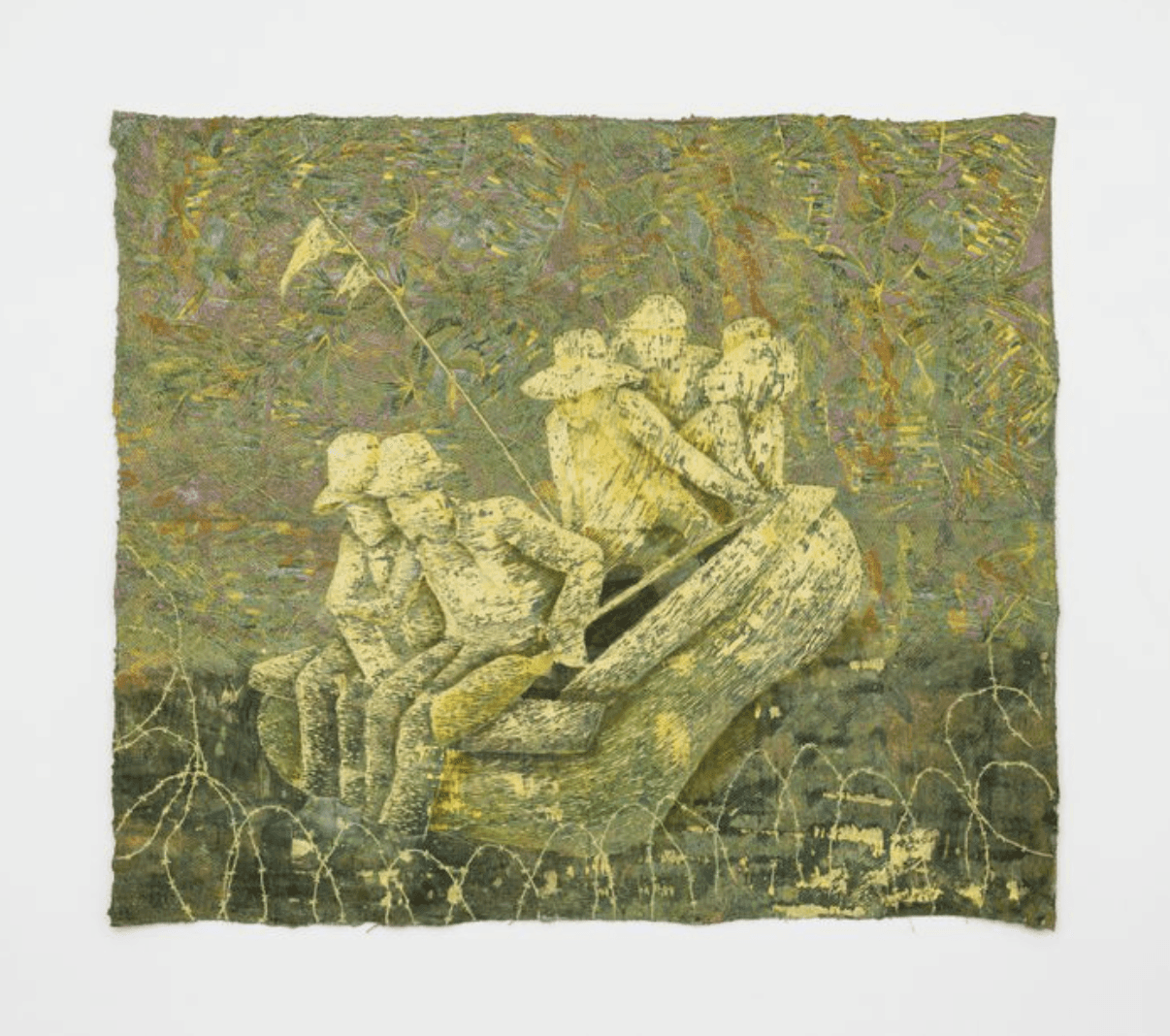
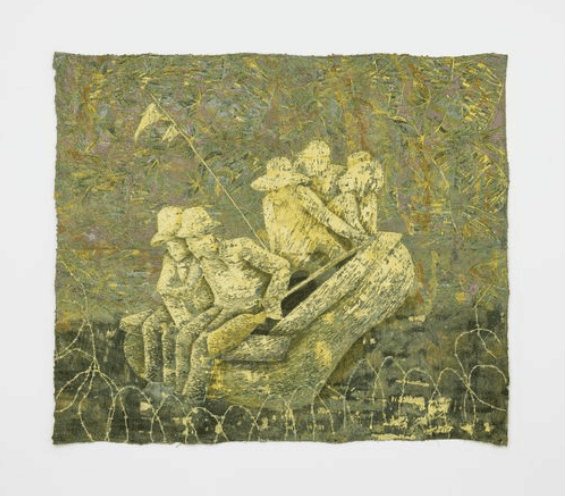
The crowded vessels that dominate her work evoke the perilous crossings that define contemporary migratory experience, particularly within the Caribbean and the broader Global South. Bodies are pressed together in precarious intimacy, caught between the promise of arrival and the certainty of risk, suspended between past and future, belonging and erasure. The sea emerges as both conduit and abyss, reflecting spiralism’s insistence that movement rarely leads to resolution and that history repeats its violence in recursive cycles. In St. Hilaire’s imagery, the boat becomes a spiral in itself—circling despair, endurance, and fleeting hope without offering closure. Migration here is less a journey than an unending search, where bodies form a living spiral, propelled forward by hope even as they remain shadowed by historical trauma and political abandonment.


St. Hilaire’s figures positioned behind barbed wire intensify this atmosphere of confinement and suspension. Here, the border no longer functions as a simple territorial marker; it becomes an interiorized apparatus of control, a psychic cage that reshapes perception and selfhood. The barbed wire does more than threaten the body—it severs speech, memory, and the capacity to imagine a future. These images resonate with literary and testimonial accounts of dictatorship and exile, in which political violence shatters subjectivity and reduces permanently unstable status: visible yet illegitimate, breathing yet circumscribed.


The crowded vessels that dominate her work evoke the perilous crossings that define contemporary migratory experience, particularly within the Caribbean and the broader Global South. Bodies are pressed together in precarious intimacy, caught between the promise of arrival and the certainty of risk, suspended between past and future, belonging and erasure. The sea emerges as both conduit and abyss, reflecting spiralism’s insistence that movement rarely leads to resolution and that history repeats its violence in recursive cycles. In St. Hilaire’s imagery, the boat becomes a spiral in itself—circling despair, endurance, and fleeting hope without offering closure. Migration here is less a journey than an unending search, where bodies form a living spiral, propelled forward by hope even as they remain shadowed by historical trauma and political abandonment.


St. Hilaire’s figures positioned behind barbed wire intensify this atmosphere of confinement and suspension. Here, the border no longer functions as a simple territorial marker; it becomes an interiorized apparatus of control, a psychic cage that reshapes perception and selfhood. The barbed wire does more than threaten the body—it severs speech, memory, and the capacity to imagine a future. These images resonate with literary and testimonial accounts of dictatorship and exile, in which political violence shatters subjectivity and reduces permanently unstable status: visible yet illegitimate, breathing yet circumscribed.

kathia st. Hilaire

Bato Espiral I, 2026

Acrylic and oil relief on canvas backed with muslin

Estimated: 149.9 × 130.8 cm | 59 x 51.5 inches

Details & Inquiry
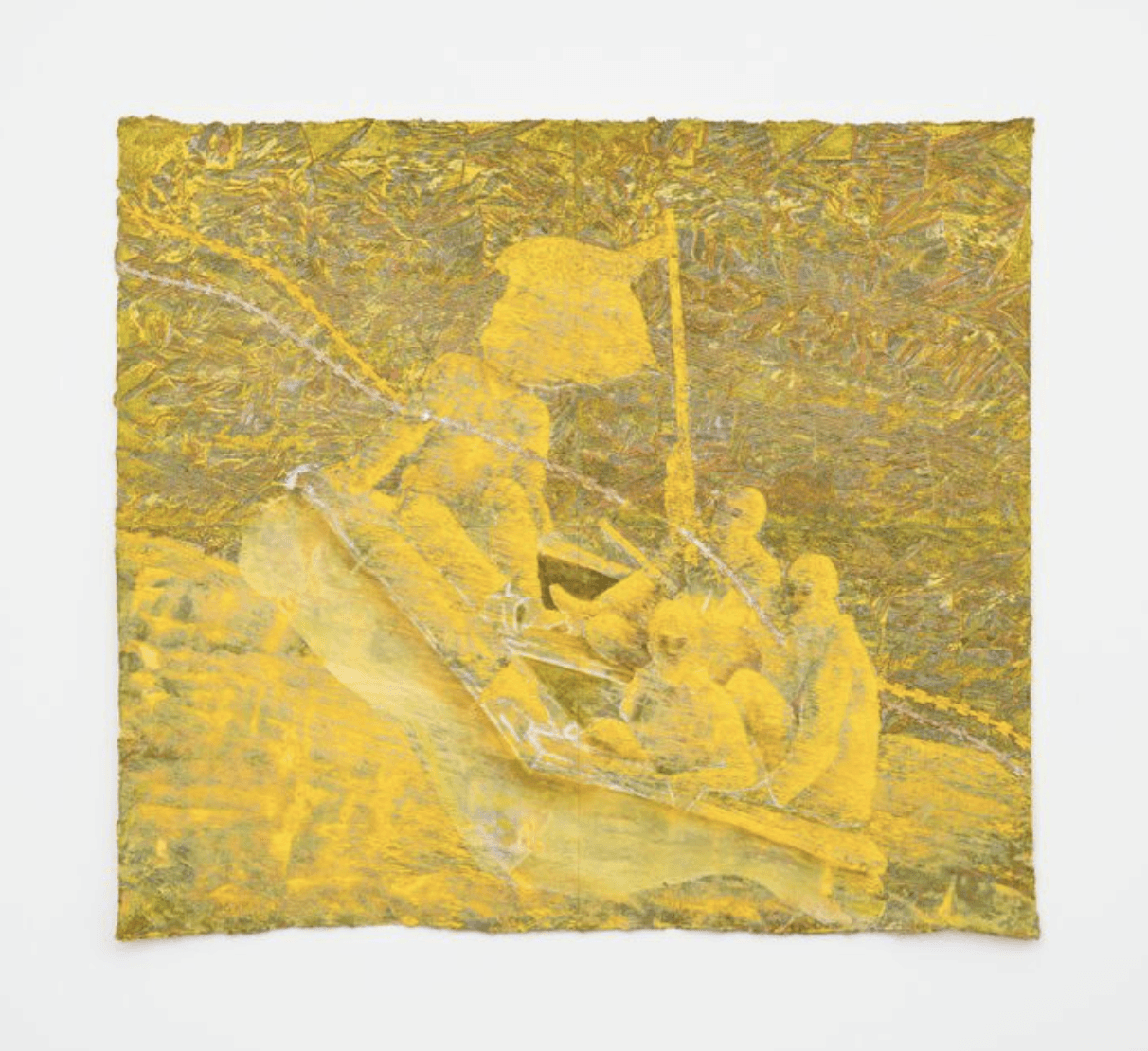
kathia st. Hilaire

Bato Espiral II, 2026

Acrylic and oil relief on canvas, barbed wire, backed with muslin collage

149.9 × 132.1 cm | 59 × 52 inches

Details & Inquiry
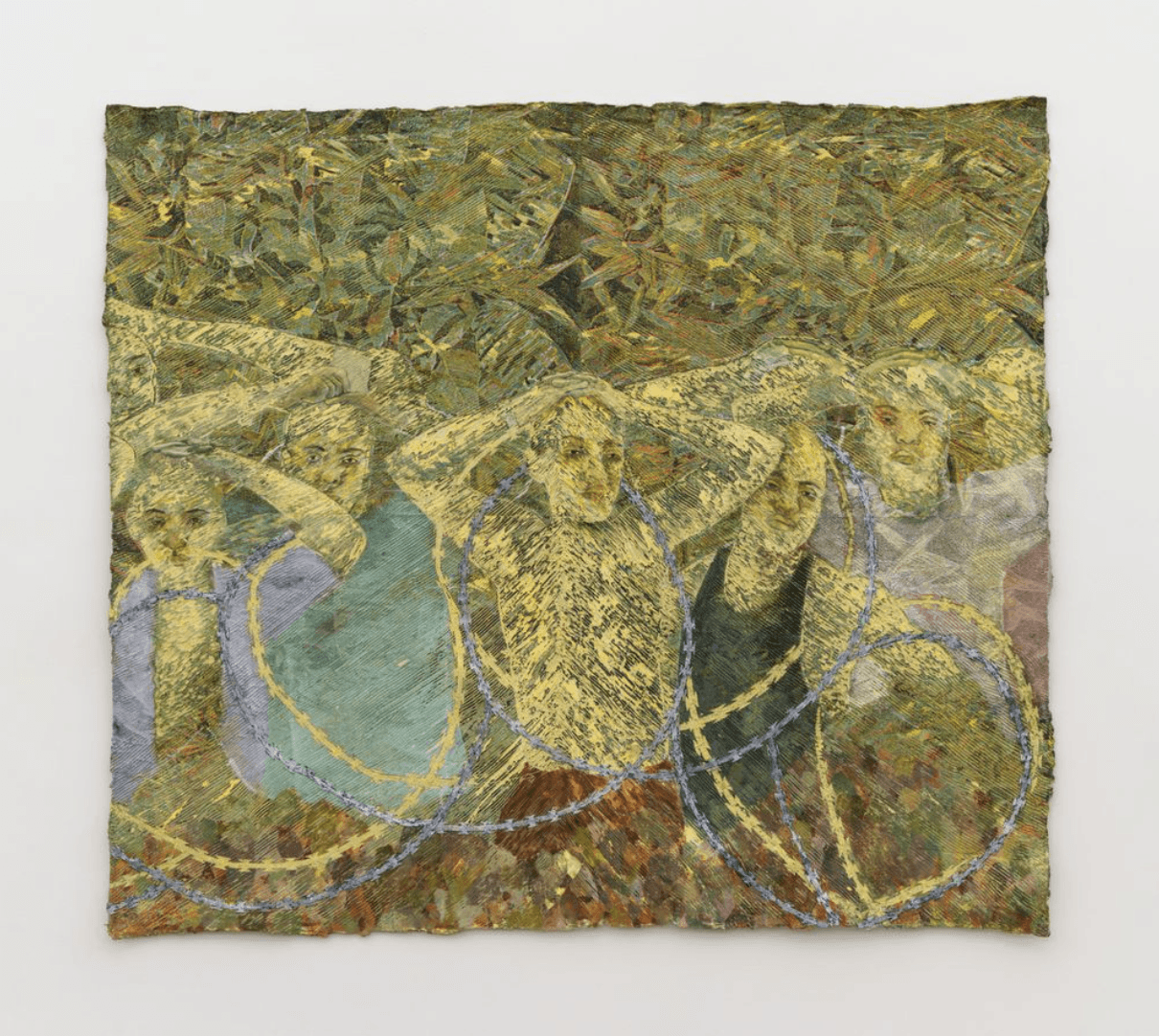
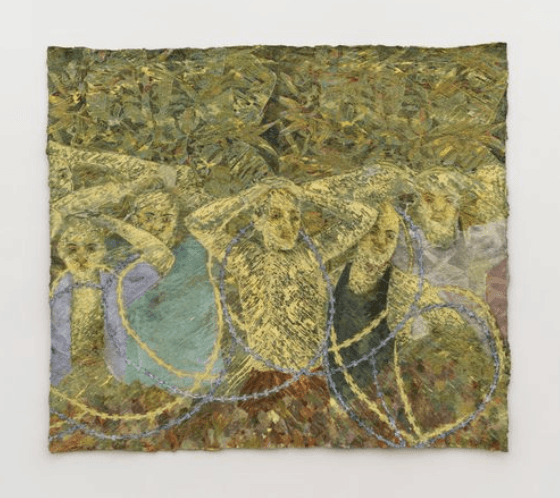
kathia st. Hilaire

Guantánamo Bay I, 2025

Acrylic and oil relief on canvas, barbed wire, backed with muslin collage

147.3 x 129.5 cm | 58 × 51 inches

Details & Inquiry

Guantanamo Bay I /II

This artwork vividly recalls historical photos of Haitians detained at the US Guantanamo Bay Naval Base. One scene in particular recalls the miserable fate of Haitian would-be refugees and asylum seekers who were held there in abysmal conditions in the 1990s during the military coup against Haitian President Aristide. With these detention scenes, St. Hilaire shows that history is repeating itself, focusing on present-ing the past. St. Hilaire uses sanded-down barbed wire/the impression of barbed wire to literally incorporate this sterile, harsh material which continues to separate and divide people through immigration, land, and borders.

This artwork vividly recalls historical photos of Haitians detained at the US Guantanamo Bay Naval Base. One scene in particular recalls the miserable fate of Haitian would-be refugees and asylum seekers who were held there in abysmal conditions in the 1990s during the military coup against Haitian President Aristide. With these detention scenes, St. Hilaire shows that history is repeating itself, focusing on present-ing the past. St. Hilaire uses sanded-down barbed wire/the impression of barbed wire to literally incorporate this sterile, harsh material which continues to separate and divide people through immigration, land, and borders.

Raynand - Tonton Macoute

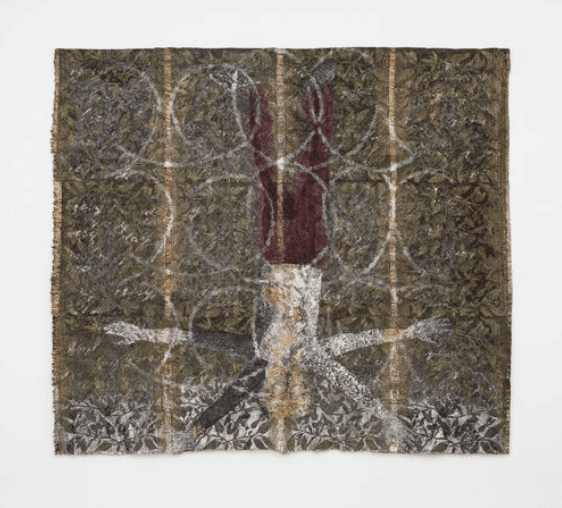
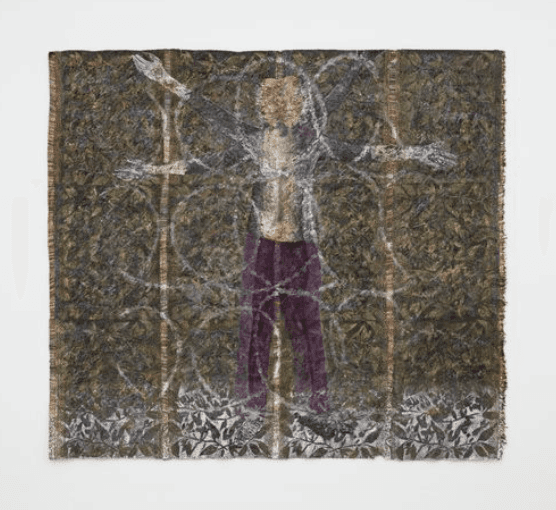
Drawing inspiration from Franketienne’s novel Ready to Burst, St. Hilaire imagines a passage in which the main character, Raynand, has awoken to find himself beaten and bruised, leaning against a lamppost. Franketienne’s novel centers around Raynand’s experience and daily life during an oppressive dictatorship, though without ever directly mentioning those involved in the regime. In this scene, Raynand has been attacked by the paramilitary group Tonton Macoute, and St. Hilaire evokes the lines of the novel which describe Raynand waking in an unknown street, his body described as being on fire with pain, lost and confused.


The Tonton Macoute was created by dictator François “Papa Doc” Duvalier and utilized as his secret police force, backed by American funding. Duvalier grew up amid the US intervention in Haiti, which was marked by racist and anti-Haitian policies. As a response, he was influenced by Noirism, a political and cultural movement which developed after the US occupation, centering the incorporation of local, Haitian culture into social and political life. Noirism was then subverted during the Duvalier era to maintain support and legitimacy during an era of heavy repression. Despite the anti-American leanings of his Noirist policies, Duvalier accepted American funding to create his paramilitary group, as the pressure to protect American shores from the reach of Communism mounted during the Cold War. St. Hilaire references this history to underscore the non-linear, chaotic reasonings and policies of Duvalier’s regime.

Drawing inspiration from Franketienne’s novel Ready to Burst, St. Hilaire imagines a passage in which the main character, Raynand, has awoken to find himself beaten and bruised, leaning against a lamppost. Franketienne’s novel centers around Raynand’s experience and daily life during an oppressive dictatorship, though without ever directly mentioning those involved in the regime. In this scene, Raynand has been attacked by the paramilitary group Tonton Macoute, and St. Hilaire evokes the lines of the novel which describe Raynand waking in an unknown street, his body described as being on fire with pain, lost and confused.


The Tonton Macoute was created by dictator François “Papa Doc” Duvalier and utilized as his secret police force, backed by American funding. Duvalier grew up amid the US intervention in Haiti, which was marked by racist and anti-Haitian policies. As a response, he was influenced by Noirism, a political and cultural movement which developed after the US occupation, centering the incorporation of local, Haitian culture into social and political life. Noirism was then subverted during the Duvalier era to maintain support and legitimacy during an era of heavy repression. Despite the anti-American leanings of his Noirist policies, Duvalier accepted American funding to create his paramilitary group, as the pressure to protect American shores from the reach of Communism mounted during the Cold War. St. Hilaire references this history to underscore the non-linear, chaotic reasonings and policies of Duvalier’s regime.

Kathia St. Hilaire, Head Whisper, 2022, oil based relief, collage, paper, metal, thread. Courtesy of the artist
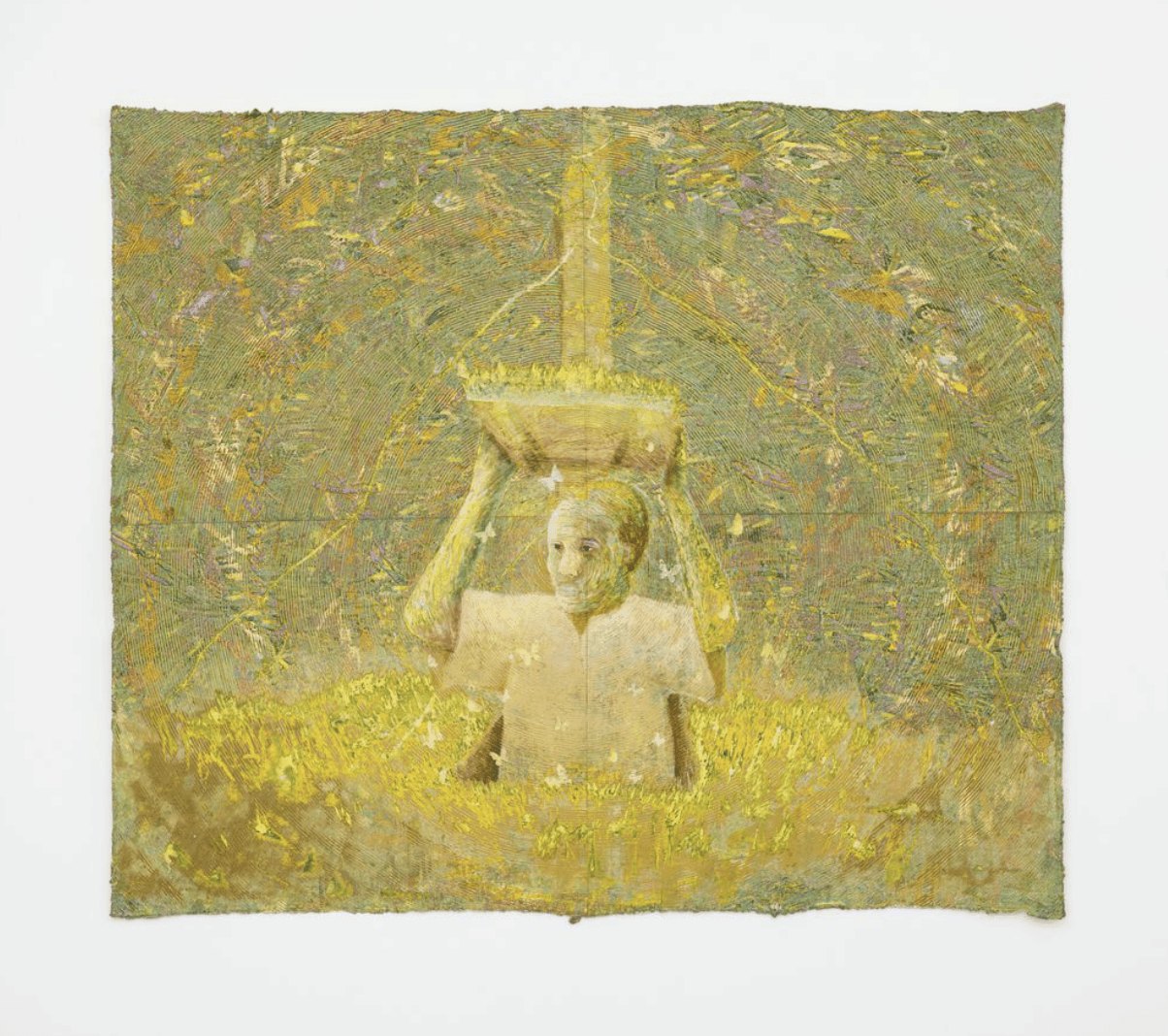
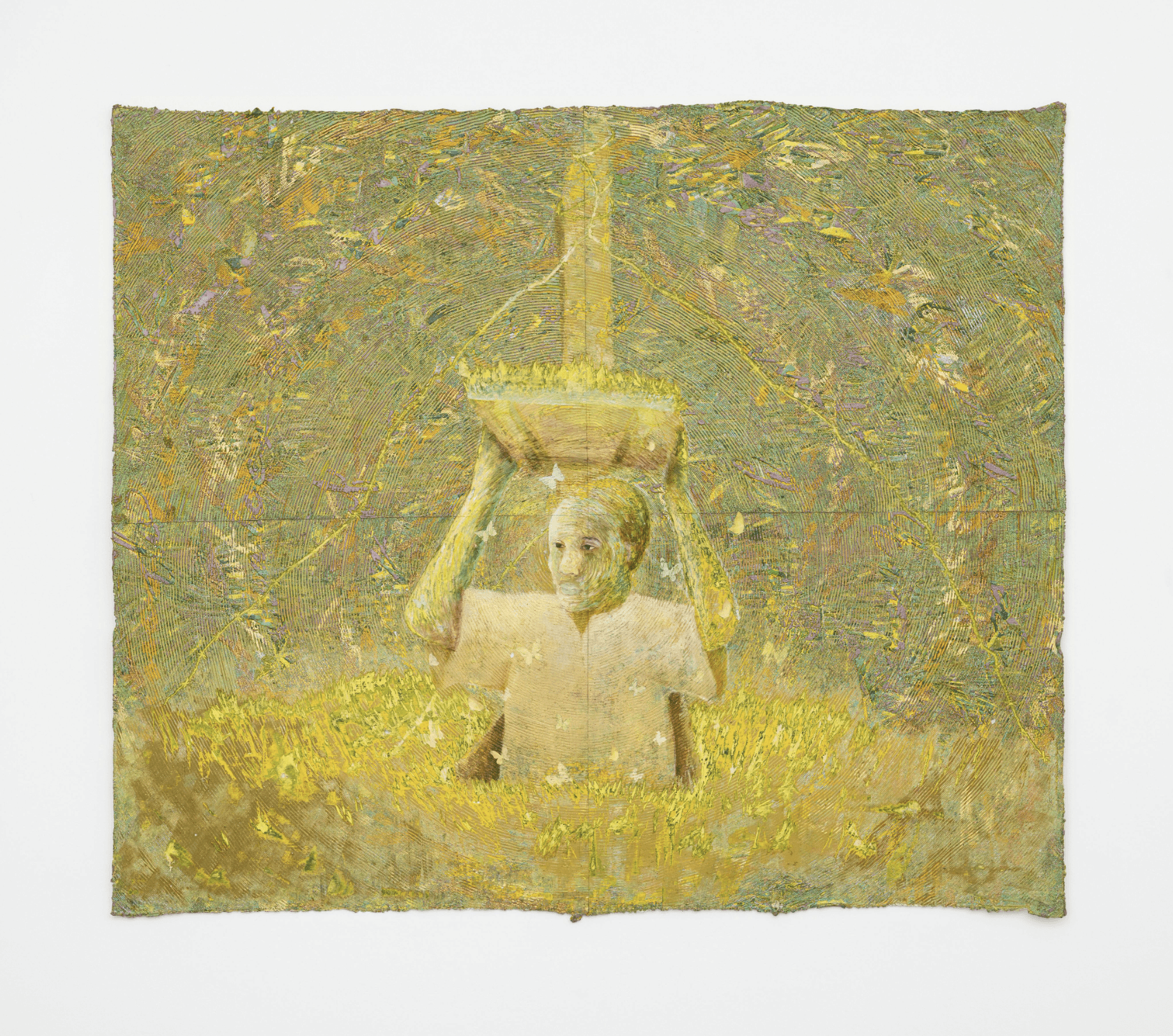
kathia st. Hilaire

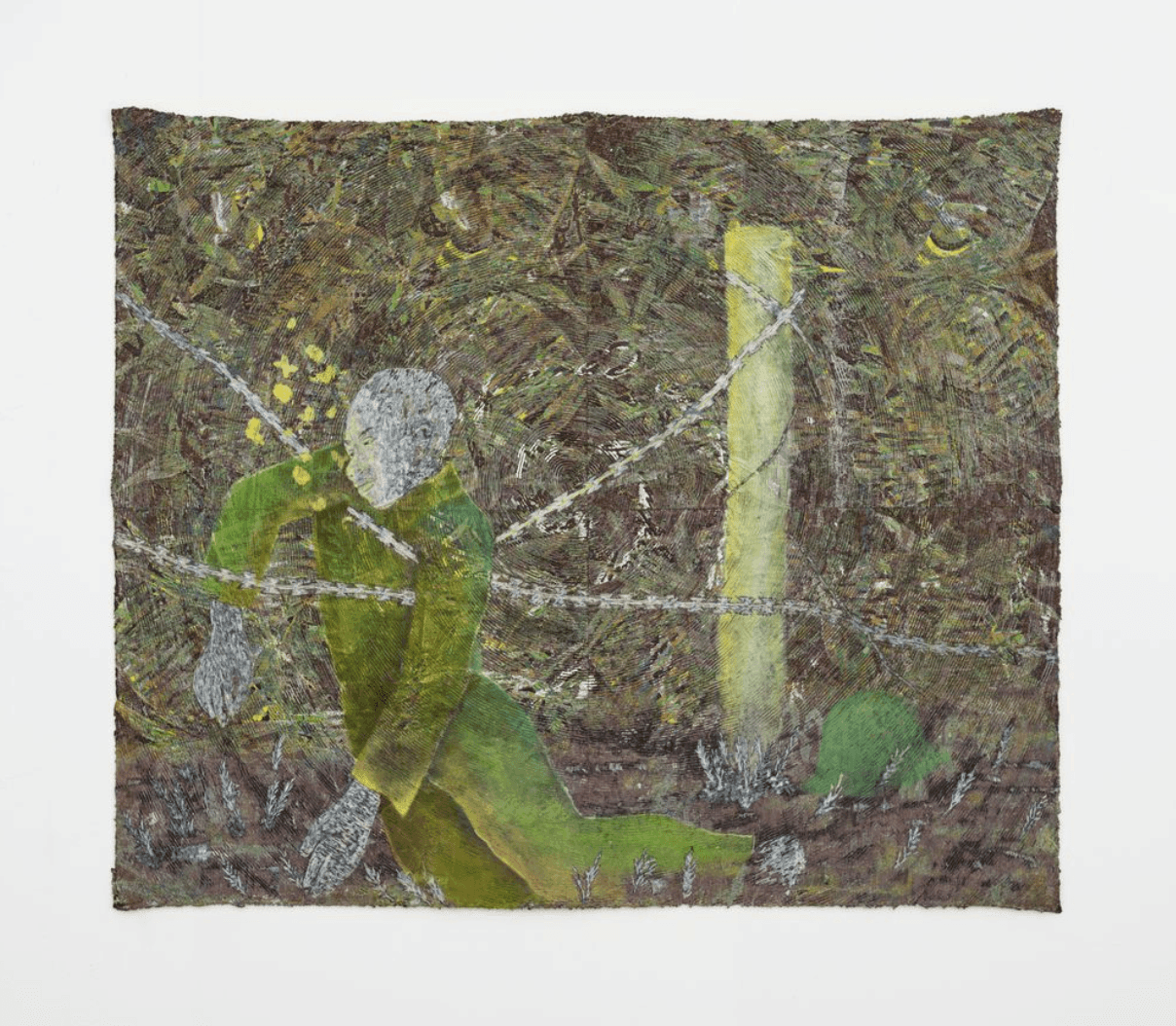
Vietnam Tunnels, 2026

Acrylic and oil relief on canvas backed with muslin

149.9 × 129.5 cm | 59 x 51 inches

Details & Inquiry

Vietnam Tunnels

While looking at photographs from the Duvalier regime in Haiti, St. Hilaire began to take an interest in wartime photography from other areas around the same period. In Ready to Burst, Frankétienne mentions the Vietnam War, which unfolded during Duvalier’s regime (1957–1971). In this work, she depicts a Vietnamese citizen emerging from a tunnel constructed to evade US forces during the Vietnam War. Linking the experienced conflicts in Haiti to the conflicts in Vietnam, St. Hilaire explores the unified chaos of warfare on the everyday civilians, who must adapt to the ever-changing circumstances of danger in their daily lives. In this sense, St. Hilaire views Spiralism as extending to this Vietnamese citizen, wrapped up in the chaos and tumult of quotidian conflict.


While looking at photographs from the Duvalier regime in Haiti, St. Hilaire began to take an interest in wartime photography from other areas around the same period. In Ready to Burst, Frankétienne mentions the Vietnam War, which unfolded during Duvalier’s regime (1957–1971). In this work, she depicts a Vietnamese citizen emerging from a tunnel constructed to evade US forces during the Vietnam War. Linking the experienced conflicts in Haiti to the conflicts in Vietnam, St. Hilaire explores the unified chaos of warfare on the everyday civilians, who must adapt to the ever-changing circumstances of danger in their daily lives. In this sense, St. Hilaire views Spiralism as extending to this Vietnamese citizen, wrapped up in the chaos and tumult of quotidian conflict.

Trenches

While looking at photographs from the Duvalier regime in Haiti, St. Hilaire began to take an interest in wartime photography from other areas around the same period. Inspired by photographs of World War I trenches and the frequent use of barbed wire, St. Hilaire extends her Spiralist lens to the Western front. She was drawn to barbed wire for its coiled, spiraled form, as well as its historical use across warfare, immigration, and violent occupations, and here the material itself is imprinted into the canvas. To St. Hilaire, the spirals of the wire evoke the chalkboard paintings of Cy Twombly from which she also draws inspiration, which were created around the time of Duvalier’s Haitian dictatorship.

While looking at photographs from the Duvalier regime in Haiti, St. Hilaire began to take an interest in wartime photography from other areas around the same period. Inspired by photographs of World War I trenches and the frequent use of barbed wire, St. Hilaire extends her Spiralist lens to the Western front. She was drawn to barbed wire for its coiled, spiraled form, as well as its historical use across warfare, immigration, and violent occupations, and here the material itself is imprinted into the canvas. To St. Hilaire, the spirals of the wire evoke the chalkboard paintings of Cy Twombly from which she also draws inspiration, which were created around the time of Duvalier’s Haitian dictatorship.

kathia st. Hilaire

Trenches, 2026

Acrylic and oil relief on canvas backed with muslin

149.9 × 137.2 cm | 59 x 54 inches

Details & Inquiry
In the first spiralist novel, Ready to Burst (1968), Frankétienne frequently disrupts his protagonists’ narrative with autobiographical interjections, introducing lyrical outbursts into an already unstable structure. These dreams, anecdotes, and poems coalesce into a portrait of the author’s formative years as a marginalized youth in Haiti. Within the novel’s carefully orchestrated chaos, the ordinary and the extraordinary intersect, and the autobiographical often appears more surreal than the fictional. Recalling news of a distant war fought on faraway shores—namely, World War II—the narrator reflects:


The episodes of war, distorted by the popular imagination, seasoned with a dash of the marvelous, populated our interior lives. Our heads were potpourris of nightmares and bloody dreams. Hitler was introduced to me by my cousin (who didn’t know much more than I did) as some sort of dragon. A magician. … Waking at night to use the toilet, I was actually afraid that I’d find him in my room—with that lock of hair on his furious forehead and that nervous mustache.


In our neighborhood, Bel Air, there lived an Italian named Papito, a deserter from Mussolini's army. Taking advantage of the black market, he'd been able to make some money selling soap made out of guaiacum wood….And I'm not sure why, but today these two facts are permanently linked in my memory: Lescot's unthinking bravado and the suicide by hanging of Papito the Italian.

In the first spiralist novel, Ready to Burst (1968), Frankétienne frequently disrupts his protagonists’ narrative with autobiographical interjections, introducing lyrical outbursts into an already unstable structure. These dreams, anecdotes, and poems coalesce into a portrait of the author’s formative years as a marginalized youth in Haiti. Within the novel’s carefully orchestrated chaos, the ordinary and the extraordinary intersect, and the autobiographical often appears more surreal than the fictional. Recalling news of a distant war fought on faraway shores—namely, World War II—the narrator reflects:


The episodes of war, distorted by the popular imagination, seasoned with a dash of the marvelous, populated our interior lives. Our heads were potpourris of nightmares and bloody dreams. Hitler was introduced to me by my cousin (who didn’t know much more than I did) as some sort of dragon. A magician. … Waking at night to use the toilet, I was actually afraid that I’d find him in my room—with that lock of hair on his furious forehead and that nervous mustache.


In our neighborhood, Bel Air, there lived an Italian named Papito, a deserter from Mussolini's army. Taking advantage of the black market, he'd been able to make some money selling soap made out of guaiacum wood….And I'm not sure why, but today these two facts are permanently linked in my memory: Lescot's unthinking bravado and the suicide by hanging of Papito the Italian.

kathia st. Hilaire

Born in West Palm Beach, USA
Lives and works in New York

Born in West Palm Beach, USA
Lives and works in New York

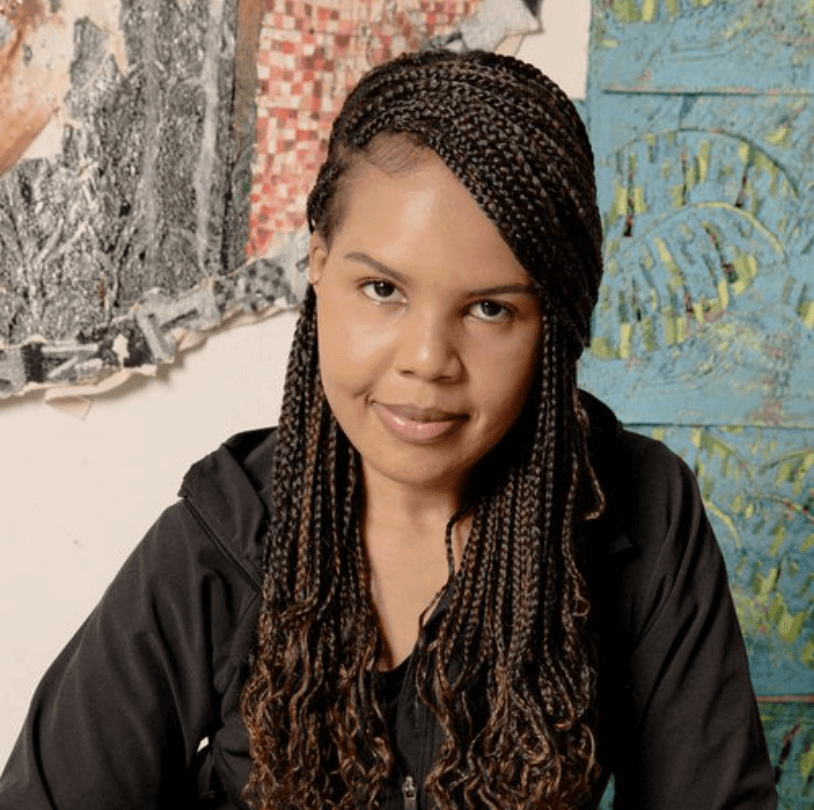
Informed by her experience growing up in Caribbean and African American neighborhoods in South Florida, the artist seeks to memorialize the communities that she has been a part of through innovative printmaking techniques. Her work draws inspiration from Haitian Vodun flags, which are used to tell the country’s history and honor ancestral spirits. Using nontraditional materials such as beauty products, industrial metal, fabric or tires, she creates ornate tapestries that seek to preserve the Haitian history and Vodun religion that lives around us in Miami.


Kathia St. Hilaire received her M.F.A. in Painting and Printmaking at the Yale School of Art in New Haven, Connecticut and her B.F.A. in Printmaking at the Rhode Island School of Design in Providence, Rhode Island. Her work has recently been featured in solo shows at the Clark Art Institute, Williamstown, MA; Perrotin, New York, NY; and the NSU Art Museum Ft. Lauderdale, Ft. Lauderdale, FL; as well as group exhibitions at the Speed Museum of Art, Louisville, KY; The Frances Young Tang Teaching Museum and Art Gallery at Skidmore College, Saratoga Springs; Half Gallery, New York; Blum & Poe, New York; and James Fuentes, New York.

Informed by her experience growing up in Caribbean and African American neighborhoods in South Florida, the artist seeks to memorialize the communities that she has been a part of through innovative printmaking techniques. Her work draws inspiration from Haitian Vodun flags, which are used to tell the country’s history and honor ancestral spirits. Using nontraditional materials such as beauty products, industrial metal, fabric or tires, she creates ornate tapestries that seek to preserve the Haitian history and Vodun religion that lives around us in Miami.


Kathia St. Hilaire received her M.F.A. in Painting and Printmaking at the Yale School of Art in New Haven, Connecticut and her B.F.A. in Printmaking at the Rhode Island School of Design in Providence, Rhode Island. Her work has recently been featured in solo shows at the Clark Art Institute, Williamstown, MA; Perrotin, New York, NY; and the NSU Art Museum Ft. Lauderdale, Ft. Lauderdale, FL; as well as group exhibitions at the Speed Museum of Art, Louisville, KY; The Frances Young Tang Teaching Museum and Art Gallery at Skidmore College, Saratoga Springs; Half Gallery, New York; Blum & Poe, New York; and James Fuentes, New York.

list of artworks

list of artworks

ROOM 1

kathia st. Hilaire

puɐuʎɐꓤ uɐW uɐᴉʌnɹʇᴉΛ, 2026

Acrylic and oil relief on canvas backed with muslin collage and woven with steel and skin lightening cream packaging

Estimated : 177.8 × 198.1 cm | 70 × 78 inches

Details & Inquiry
kathia st. Hilaire

Jérémie Vespers I, 2026

Acrylic and oil relief on canvas backed with muslin collage and woven with steel and skin lightening cream packaging

213.4 × 160 cm | 84 × 63 inches

Details & Inquiry
kathia st. Hilaire

Vitruvian Man Raynand, 2026

Acrylic and oil relief on canvas backed with muslin collage and woven with steel and skin lightening cream packaging

Approx : 177.8 × 198.1 cm | 70 × 78 inches

Details & Inquiry

ROOM 2
kathia st. Hilaire

Jérémie Vespers II, 2026

Acrylic and oil relief on canvas, barbed wire, backed with muslin

Approx : 149.9 × 129.5 cm | 59 × 51 inches

Details & Inquiry
kathia st. Hilaire

Bato Espiral I, 2026

Acrylic and oil relief on canvas backed with muslin

Estimated : 149.9 × 130.8 cm | 59 × 51.5 inches

Details & Inquiry
kathia st. Hilaire

Guantánamo Bay I, 2025

Acrylic and oil relief on canvas, barbed wire, backed with muslin collage

147.3 × 129.5 cm | 58 × 51 inches

Details & Inquiry
kathia st. Hilaire

Spiral Execution, 2025

Acrylic and oil relief on canvas backed with muslin

149.9 × 129.5 cm | 59 × 51 inches

Details & Inquiry
kathia st. Hilaire

Vietnam Tunnels, 2026

Acrylic and oil relief on canvas backed with muslin

149.9 × 129.5 cm | 59 × 51 inches

Details & Inquiry
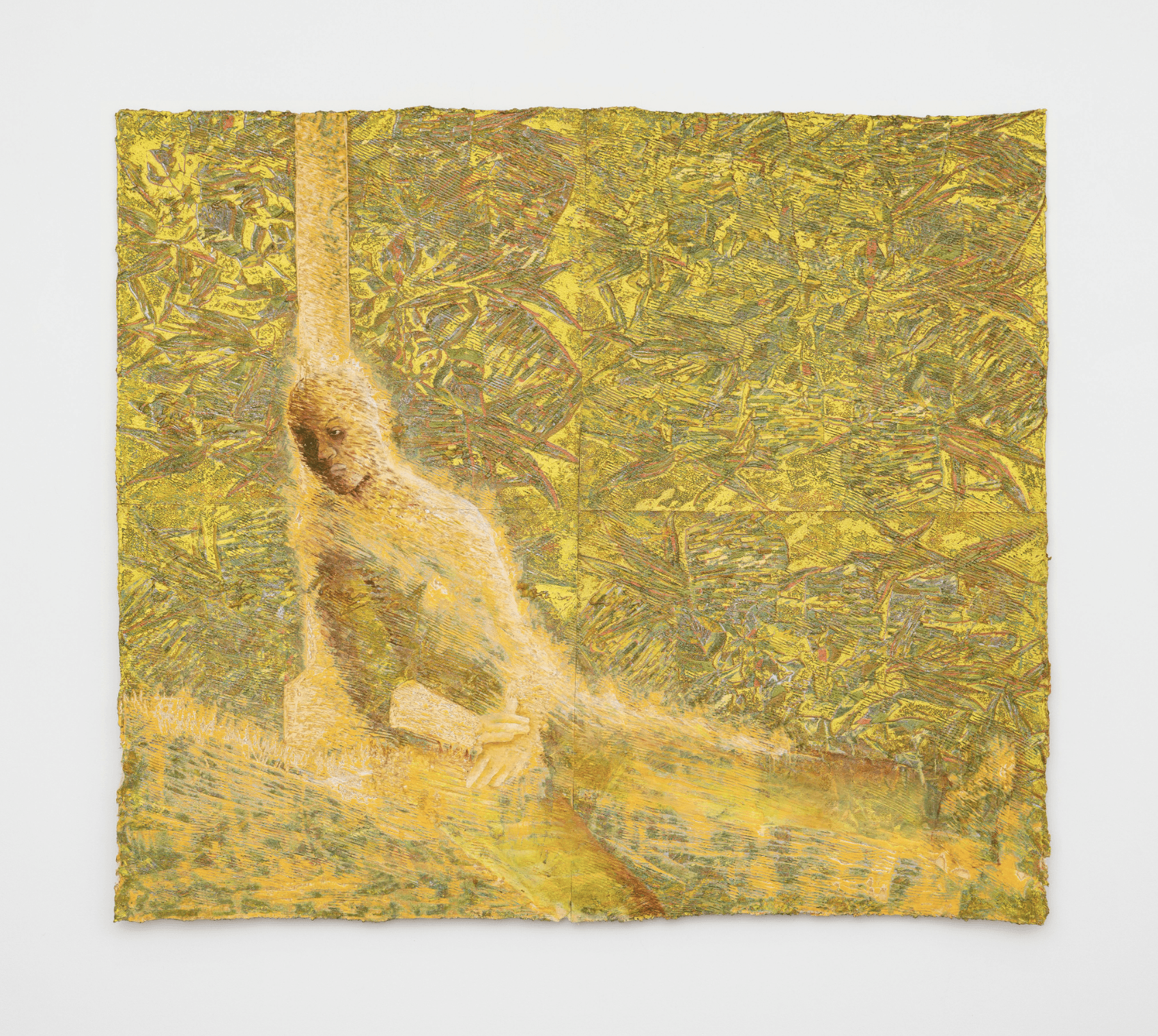
kathia st. Hilaire

Raynand - Tonton Macoute, 2026

Acrylic and oil relief on canvas backed with muslin collage

149.9 × 137.2 cm | 59 × 54 inches

Details & Inquiry
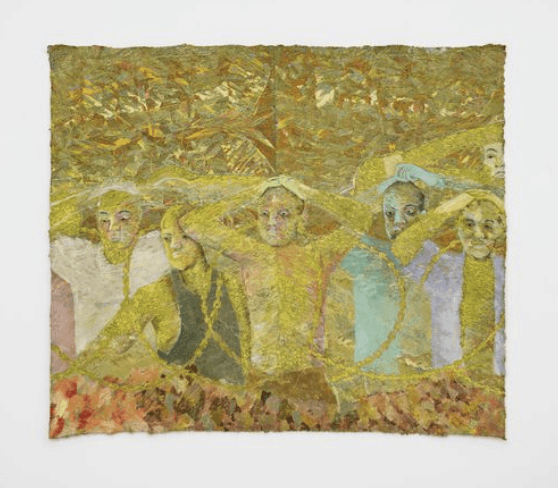
kathia st. Hilaire

II Yab Omanatnaug, 2026

Acrylic and oil relief on canvas backed with muslin collage

Approx : 149.9 × 129.5 cm | 59 × 51 inches

Details & Inquiry
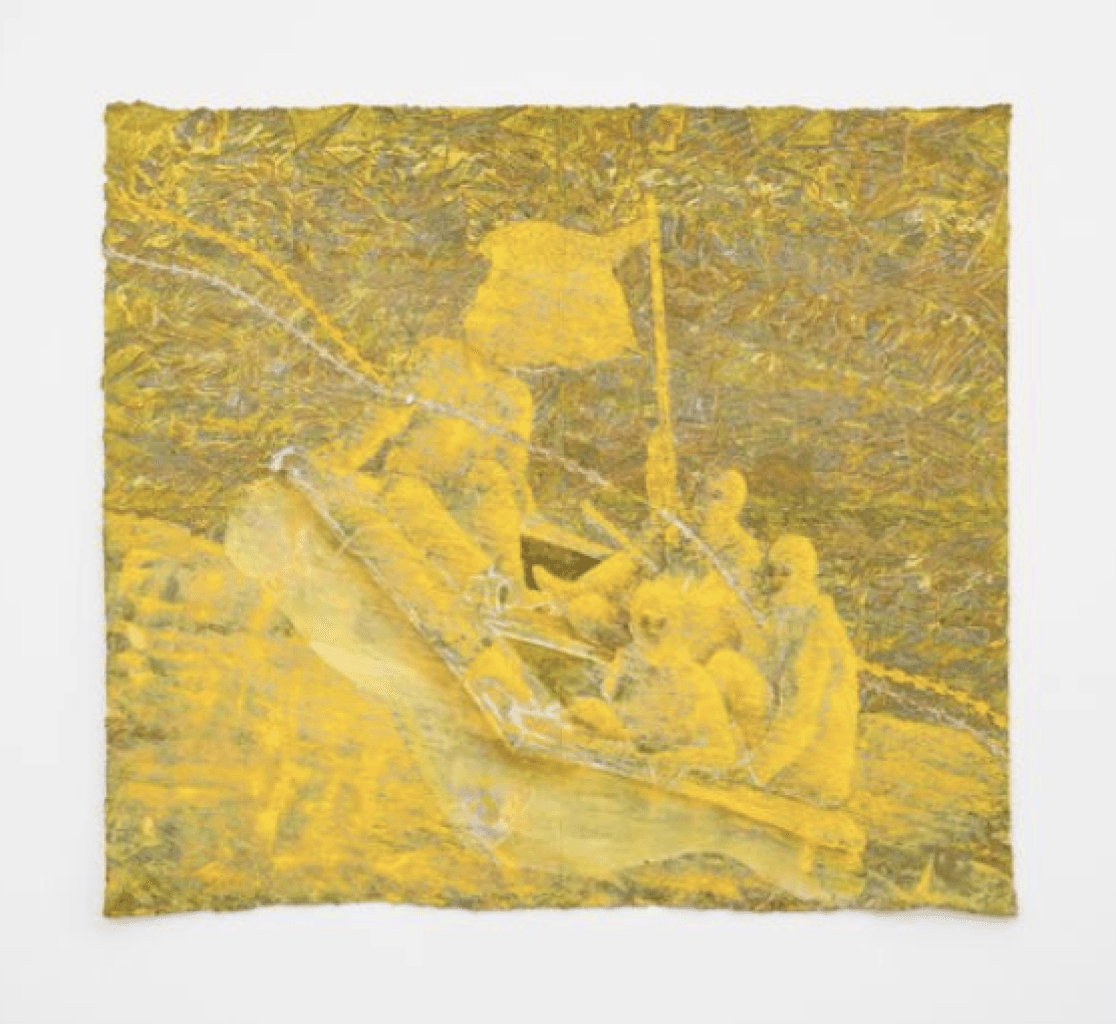
kathia st. Hilaire

Bato Espiral II, 2026

Acrylic and oil relief on canvas, barbed wire, backed with muslin collage

149.9 × 132.1 cm | 59 × 52 inches

Details & Inquiry

ROOM 3
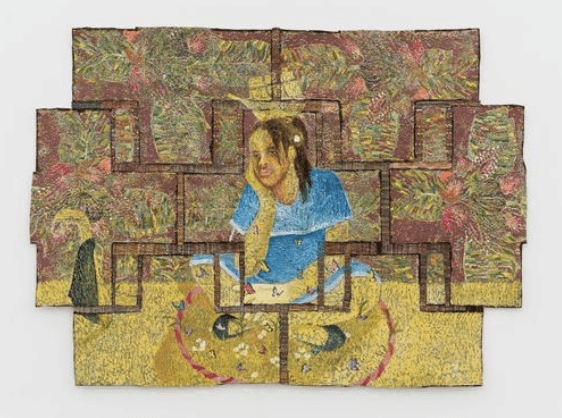
kathia st. Hilaire

Untitled, 2025

Oil based relief on canvas collage with paper, steel, skin lightening packaging

106 × 148.6 cm | 41.75 × 58.5 inches

Details & Inquiry
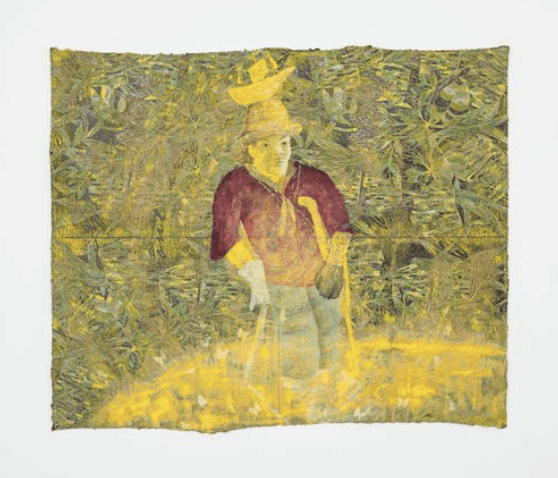
kathia st. Hilaire

Vagabondiana, 2026

Acrylic and oil relief on canvas backed with muslin

149.9 × 137.2 cm | 59 × 54 inches

Details & Inquiry
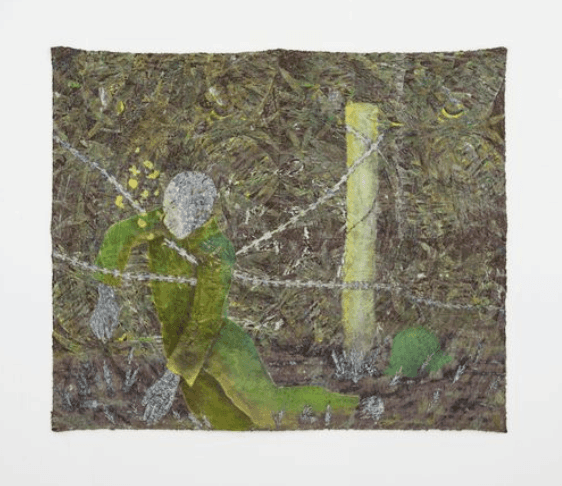
kathia st. Hilaire

Trenches, 2026

Acrylic and oil relief on canvas backed with muslin

149.9 × 137.2 cm | 59 × 54 inches

Details & Inquiry
paris marais

47 Rue de Turenne, 75003 Paris

tél : +33 12 34 56 78

paris@ouiparis.com

mardi - samedi, 10h-18h

new york

130 orchard street, New York, NY 10002@

tél : 1 (917) 123-4567

nygalery@ouiparis.com

mardi - samedi, 10h-18h

tokyo

Piramide Building 1/F, 6-6-9 ROPPONGI, MINATO-KU, TOKYO 106-0032

tél : +81 3 1234 5678

presstokyo@ouiparis.com

mardi - samedi, 10h-18h

ⓒ2026 — OUIparis / légal / crédits

ⓒ2026 — OUIparis / légal / crédits

suivez nous

suivez nous

Create a free website with Framer, the website builder loved by startups, designers and agencies.